Box 1

Box 1
STEAM

Box 2

Box 2
Character Education

Box 3

Box 3
Digital Learning
Showing posts with label Writing. Show all posts

Narrative Nonfiction Brings History to Life

 Narrative Nonfiction and the Study of History


I wanted to be a teacher as long as I can remember, even before I actually attended school. I will admit though to several side journeys as I grew. My uncle campaigned pretty hard throughout my high school and college years to study law and join his firm. Once his own children were exploring their own future careers, he stepped back. Two of his three children actually did become lawyers, and I was free once again to continue moving toward my dream of working in my own classroom. 

In college, I became extremely interested in sociology and archeology, and briefly considered a career as an archeologist. Dirty fingernails along with a dislike for working outside in extremes of weather told me that this was not a good choice for me. I believe that my intense interest in these fields of study helped me overall to be a better teacher. I never had to pretend to be excited about digging into the study of a new piece of nonfiction. I was all in from the beginning, and sometimes needed to calm down a little before presenting the lesson to my students! 

I  came across an article recently that detailed the discovery of Harriet Tubman's childhood home in Dorchester County, Maryland. The area is becoming swampier as the water level rises and the land is sinking, but when the manager of The National Blackwater Wildlife Refuge learned that Ben Ross' (Harriet Tubman's father) cabin may have been on their newly acquired land, she called in the archeologists! Their first find was a coin from 1808, the year that Harriet Tubman's parents were married. After digging over a thousand pits, the team discovered many datable artifacts, such as "...bricks, 19th century pottery with distinct design patterns, rusty nails, a button, and old documents". Historical records tell us that Harriet Tubman lived in this cabin as a child, and again as she planned her strategy of the Underground Railroad in 1849. While not finding an actual homestead or even a chimney, this find was exciting, and pulled me back to a longtime favorite book of mine.

Using literature to teach Narrative Nonfiction

Teaching Home Place by Crescent Dragonwagon (IKR? Her real name!) was always one of those "calm down first" moments for me. I love this author and the gentle and tender way she lets her story unfurl. Also majorly in love with the illustrations of Jerry Pinkney. A special book to treasure on several levels. Past and present melt into each other as watercolors do when you are working wet on wet and colors begin to merge. A family on a hike through the woods (how many times have we all done this as a family outing ?) finds daffodils growing in the wild, but no house nearby. They search further and find part of a chimney standing by itself. A little digging in the ground unearths a blue glass marble, a nail, part of a china plate, a horseshoe, a small yellow bottle, and a doll's arm. These artifacts help them to tell each other the story of a long ago family living right in the spot where they stood, having chicken for dinner, singing on the front porch, and even complaining about the heat on a summer day long before central air! If I had my hands on this book as a child, I might have veered off onto the archeology path despite the dirt and heat! Don't miss sharing this one with your kids!

Narrative Nonfiction Teaching Activities

Teaching Narrative Nonfiction is really much more intuitive than many of us think when we first approach it. Which type of writing is a nonfiction narrative? It is simply nonfiction delivered in narrative structure rather than expository. It is all true, but told as a story unfolds. Crescent Dragonwagon tells the story of a house and family as they lived circa 1900. It's recommended for grades K-3, but I used it with grades 4 and 5 for years. Fourth and fifth graders are much more likely to be able to use it as a mentor text for writing more narrative nonfiction.

A favorite followup writing activity to Home Place would be to bring a photo of an artifact from home, or an artifact discovered on a walk, and tell the story of a person or family who might have used that item in another time in history. Without using artifacts, you could also look at a particular time in history and have your fourth or fifth graders tell about that time from the viewpoint of a kid their age at that time. (I would steer clear of using this idea to study slavery or other culturally sensitive issues.) 

If you use The One and Only Ivan in your reading curriculum, there is a narrative nonfiction companion book called Ivan, the Remarkable True Story of the Shopping Mall Gorilla, also by Katharine Applegate. It would be very interesting to discuss the narrative structure of each. 

As a reading addict, I always had a book or two up my sleeve that I was reading to tell my students about as we discussed their books. I usually did not tell them the title. No need for them to read an adult book that may not be suitable in other ways, but only to show that authors who write for all ages use many of the same structures, elements, and storytelling techniques. The story of Home Place takes me back to a recently read book, The Lost Apothecary by Sarah Penner. A tourist in London goes "mudlarking" and finds a mysterious blue bottle on the shore of the Thames. We then embark on parallel stories of the tourist trying to trace the history of the bottle and a history told of a time when apothecaries sometimes prepared secret potion poisons for abused women to dispatch their abusers. I would share only the story of the bottle find and the historical search that ensued, of course! If you haven't read this book yet, you might want to add it to your own summer reading list. So good!

Some suggested narrative nonfiction texts (in addition to Ivan) are: Camp Panda by Catherine Thimmesh, A Seal Named Patches by Roxanne Beltran, The Boo Boos that Changed the World by Barry Wittenstein, and Hidden Figures by Margot Lee Shetterly. This list could go on for pages and pages.

For more ideas on teaching Narrative Nonfiction, be sure to check out these resources from Rainbow City Learning on TpT!


If you would also like to be a part of Teacher Talk, we are a group of teacher bloggers who share posts that are heavy on the ideas with just a little selling of our educational materials at TeachersPayTeachers.com.  For more information about joining The Best of Teacher Entrepreneurs Marketing Cooperative, go to https://bit.ly/3o7D1Dv.  Feel free to email me at retta.london@gmail.com if you have any questions. 


You are invited to the Inlinkz link party!
1

Seven Fun Halloween Candy Activities for Your Class


Fun Candy Activities for Kids

It's Candy O'Clock! The store shelves may be lacking some essential paper items, but they are currently chock full of Halloween candy of every description in those cute little individual bags! Trick or Treating is so much fun, but how many kids can actually eat all the candy in their haul? It's estimated that most kids will consume about 3,190 empty calories from their Trick or Treat bags. For most kids, that won't even make a dent in the stash. Here are some suggestions to make better use of the annual sugar rush and make your classroom goblins want to share!

Switch Witch

The Legend of the Switch Witch

My head is currently spinning while trying to find out who owns the concept of the Switch Witch. Apparently, you can't copyright an idea and so the Switch Witch legend is now part of the public domain. The original Switch Witch book is available on that book selling internet giant and also at some smaller booksellers. I purchased a cute witch and book from a Colorado company (switchwitches.com) which I thought would be useful for upper elementary students. This book talks about the magic of Switchcraft. 

The legend was originally created to help a diabetic toddler to see another use for the trick or treat candy that she couldn't eat. According to legend, various Switch Witches travel all over the world before Halloween. They will exchange your Halloween candy for other fun toys/gifts. They watch over you in a way similar to the Elf on a Shelf concept.

My classroom application: My Rainbow City classroom always had a store (We called it the Rainbow City Boutique!) open on Fridays. Kids could exchange classroom dollars earned through good behavior and work efforts for school supplies, handmade items by their classmates, or materials to make their own items to sell. More about how this economy worked can be found here

Whether you have a classroom shop or not, you can place a cute witch doll on a table next to a box which can be sealed (like a plastic storage container with lid). Our school was on the edge of a forest. Forests have mice. Need I say more? Didn't think so. 

After Halloween, your students can bring their wrapped Halloween candy to school and trade it in for whatever you (The Switch Witch) decide to offer in exchange. You can use a witch doll or dress up yourself. I'm pretty sure that a parent might be willing to dress up and volunteer for this job as well!

For a followup writing activity, ask your students to write a letter to the Switch Witch about what they would like in exchange for their candy! Find that activity here: 

What will you do with all the candy you collect? Save it and read on!

Harriet's Halloween

Many years ago, an AIMS (Activities in Math and Science) activity was published in their journal using the picture book Harriet's Halloween Candy. The story was about an anthropomorphic dog who didn't want to share her Halloween Candy. The activity was all about sorting according to different attributes such as chocolate/not chocolate, individually wrapped/package wrapped, plastic wrappers/paper wrappers, by color, by ones they like/don't like, etc. 

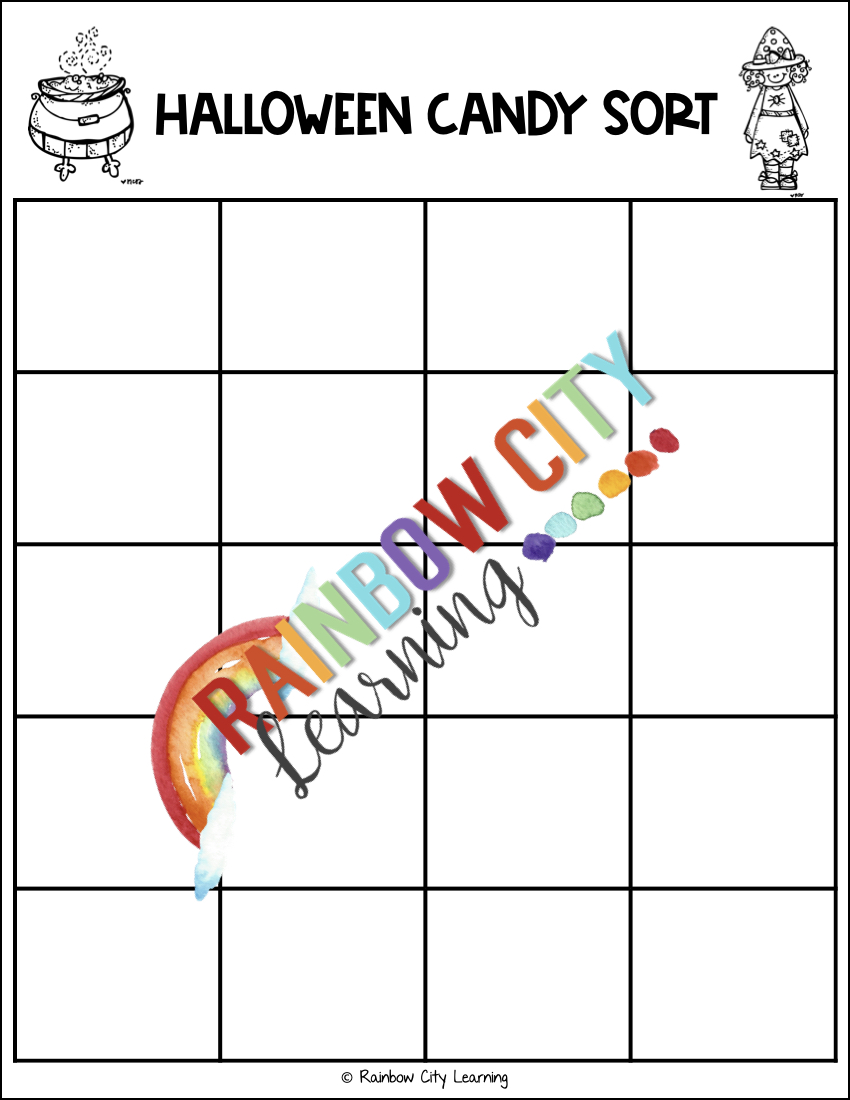
Upper elementary kids should be able to come up with four different ways to sort their stash. I made a sorting page for you to use below. You're welcome.

After sorting, my class would make goody bags to be handed out at the local food pantry as a treat for homeless kids or those unable to trick or treat in their own neighborhoods. Some senior citizens centers will take these donations also. 

Cute graphics on this page are from Melonheadz.

Harriet's Halloween Candy Activity


Getting to Know Us Again

Depending on how quickly you opened your room and got students back to school, you may or may not have tried this fun Morning Meeting activity. You can play it with Skittles, M&Ms, or any wrapped small candies. I've played it with pennies, and some teachers use toilet paper squares. As students enter the circle, ask them to "Take as many" as they need. As you go around the circle, each child has to say something about themself for each of the number of pieces they've chosen. 

This game can have so many adaptations: Say something nice about a classmate for each piece, say something new that has happened in your life for each piece, tell something new you learned in class last week for each one, use them to tell the steps of something that you know how to cook or build or create.

So many ways to reacquaint ourselves as a classroom community!

Poetry Writing

Here's a funny and fun poem for Halloween from Shel Silverstein's book, Every Thing On It. The cute graphics on this page are from the amazing Glitter Meets Glue. You're welcome again!

Kids can write their own poems, using this as a model. Who do they think invented Trick or Treating? They can also write Five Senses Poems or another poetry form about Halloween. 

The One Who Invented Halloween Page


STEAM

From Saving Sam (or Fred or...) to Pumpkin Catapults and Pretzel Stick Bridges, there are so many ways to use candy in your STEM/STEAM activities. If you've collected candy from the Switch Witch suggestion, you can use it again and again to supplement your Maker Space and STEM/STEAM activities.
Here's a fun one from my Stepping Into STEAM resource. 

Stepping Into STEAM Rainbow City Learning

Notes and Awards

Pay it forward! Use some of your "switchcrafted" stash to attach to thank you notes for PTA or Staff Appreciation days. Some years, we have sent care packages to our troops. It is also fun to attach candy to Clean Desk Awards. 


 Candy Book Discussions

 I have used M & M Book discussion cards during Daily 5 time. Wow! Not only was I able to have 10 book conferences in less than one hour, but I could really tell how deeply those books had been read. 

Worked with two multi-level groups of 5 each. Students randomly selected an M&M from their Halloween-sized bags (perfect time of year to try this), and told the group about their book as the prompt directed.
 
Did not hear one "I pass." or one "I don't know." The conversation flowed, and the students were thrilled to keep their cute laminated M & M bookmarks to prepare for their next discussion.  Eight more students signed up for conferences for the next day, and several were heard as they packed to go home that they couldn't wait to get back into their independent reading books that night.
A fun day interacting with my readers! Hope you'll try it!  

For a convenient download of the  pages shown above, just click here! (No longer free, but just a dollar! Really! Come on!)


ALL of the ideas in this post, and many more can be found in my Halloween Bundle. Save yourself some planning time, and enjoy the celebration along with your class! Just click below!

BIG NEWS!

If I can do anything else to help make your job easier this year, please let me know in the comments below! If I use your idea for a new blog post, you will win a TpT $10 gift card. If I create a new resource for Rainbow City Learning based on your idea, you will win a free copy of that resource to use in your classroom! (Note: all comments are reviewed before appearing on my blog. It may take a few hours for your comment to appear! Thanks for your patience!)


Wishing you and your class a safe and fun Halloween this year!

For more October thoughts on teaching, be sure to check out the posts below by the amazing bloggers in Teacher Talk. 

If you would also like to be a part of Teacher Talk, we are a group of teacher bloggers who share posts that are heavy on the ideas with just a little selling of our educational materials at TeachersPayTeachers.com.  For more information about joining The Best of Teacher Entrepreneurs Marketing Cooperative, go to https://bit.ly/3o7D1Dv.  Feel free to email me at retta.london@gmail.com if you have any questions. 

You are invited to the Inlinkz link party!

Click here to enter
0

Getting Kids to Write

Ideas for Kids Writing

I've joined a new book club, and the discussion this week was mind-blowing!  We were discussing The Secret Keeper of Jaipur (sequel to The Henna Artist) by Alka Joshi, and our leader informed us at the end that this author's first book was written when she was fifty-one years old! Given that our group was comprised of women of that age and older, that information caused our discussion to veer in a new direction. When the member seated next to me pointed out that there are "so many ideas floating around out there", I grabbed her arm (gently, of course...), and said, "BIG MAGIC!" All was suddenly quiet. All eyes on me, the new girl. Undaunted, I repeated, "Big Magic by Elizabeth Gilbert!" Blank faces. "You know," I went on. "The author of Eat,Pray,Love. She also wrote a book about imagination and how ideas find us." A little more interest. (Several teachers in the group.) I continued, "She said exactly what Christina just said, that ideas are free-floating in the universe, and they find us if we are open to it. If we allow the ideas to find us, we can do or write about almost anything. My friends know that I call this phenomenon 'Blog Fairies' whenever I sit down to write a blog post." 

Where Do Ideas Begin?

I love to read about and listen to interviews with my favorite writers. The common element that I have found in all of this drilling down on their creative process is the quiet surroundings and sitting with their thoughts. Just being quiet and allowing the ideas to find you. If you do research about a favorite author of yours or of your students, you will find a regular person who stood still long enough for an idea or two to find them. 

I currently have two hardcover copies of Big Magic, a Kindle edition, and an audio version. I refer to them alllll the time. If you only read one chapter, try the one about the time that the very same idea had approached both Elizabeth Gilbert and Ann Patchett. Elizabeth ignored it because she was busy with something else, and Ann wrote the book! Read about how they discovered this secret of the universe as it affected them both. The chapter is titled "WTF?" because you know... how could this be? It happened! 

Teacher friends, this concept can so easily be applied to our classroom practice. Even the most reluctant writers can be drawn in with this magical idea. Believe what you will, but something in the universe or within each of us as humans, offers ideas and opportunities on a regular basis. We choose, whether consciously or unconsciously, to tune in or tune out. We can bring this idea into our classrooms to get the writing started and to keep it going. This is no cookbook plan on how to teach writing step by step, but rather some suggestions for creating a community of writers within your classroom.

Authors Lead the Way

Author Kristen Hannah today on her FB page: "Honestly, it's always kind of a surprise to find that I can write a book!" 

Author Jodi Picoult on what to write: "...for many years, I had to squeeze in my work around child care schedules, and that made me develop a very firm discipline. I write quickly, but I also do not believe in writer’s block, because once I didn’t have the luxury of believing it. When you only have twenty minutes, you write - whether it’s garbage, or it’s good… you just DO it, and you fix it later."

Natalie Kinsey Warnock, author of Gifts From the Sea: "Every family has stories that are too good to be forgotten, stories that need to be written down and told and passed on to the next generations." My favorite memory of an author interview with this author was when she held my students and me spellbound with her sharing of how she came to write Gifts From the Sea. She was in her studio, working on another book. Quila, a character in Gifts From the Sea, kept showing up as a voice in her ear saying. "Tell my story. Tell my story." Over and over, until she could ignore it no longer. As she put down her other work, closed her eyes, and sat with the quiet, Quila's story was revealed to her and became a longtime favorite book for the middle grades. 

Beloved children's author Patricia Polacco describes her family members as marvelous storytellers. "My fondest memories are of sitting around a stove or open fire, eating apples and popping corn while listening to the old ones tell glorious stories about their homeland and the past. We are tenacious traditionalists and sentimentalists.... With each retelling our stories gain a little more Umph!"

From my current literary obsession, Black Cake: Author Charmaine Wilkerson created this novel from thoughts about a cow shaped potholder, a blue pie plate, and an old family recipe given to her by both sides of her fractured family situation growing up. "One’s sense of family and home may shift over time, but it remains embedded in our hearts and our sense of self wherever we go." 

Author Joyce Maynard leads writer's retreats several times a year at her beautiful home on Lake Atitlan in Guatemala. These are memoir writing workshops for people who have never tried to write a book, but want to explore what they have inside them.  When asked in an interview about the sequel she's currently writing to her newest book, Count the Ways, she said that she can't wait to find out what's in store for one of the characters in the first book! What?!? She can't wait?!? Isn't she the author? But what she is telling us is the same thing others have said, that the characters reveal themselves to the writer much like they do to the reader. Jodi Picoult describes it as a movie playing out in her head.

Lessons for Our Young Authors 

I could go on and on (probably already have!) about thoughts from my favorite authors, but here are some takeaways that I think will be helpful in our classrooms:

  • Be still and quiet and allow ideas, floating around like butterflies, to land on you. 
  • Start with a word, a drawing, or even a scribble. Just touch a pencil to paper or place your fingers on the keyboard, and begin.
  • Tell your own stories and stories you've heard in your family.
  • Start with a favorite favorite family recipe or artifact like a quilt and tell its story or a related one.
  • Let the story lead you, and let the characters take you where they want to go.
Get the Party Started

Shhhh.... It's a quiet party! Try creating an oasis of peace and quiet when writing time arrives. Play some soft music as an invitation to gather materials and find a quiet writing space. Some days, just give kids a quiet room, a favorite spot, and then the gift of some time to write. Some days, try an activity or game to get the juices flowing. Some activities to try:

  • The never-ending story. Start with a first sentence and pass a talking stick or ball or whatever around as each kid in turn adds the next line. You will want to video or record these! Many are keepers!
  • The quick write. Give a prompt and and allow a timed response time. Anything from 4 to 10 minutes. As Jodi Picoult says, just write! Even if you think it's garbage. It can always be revised later. It's fun to record the number of words written each time, and see the growth! 
  • A picture or quilt square about a family story or tradition.
  • Start with sharing a favorite food or recipe. 
  • Allow kids to talk about all of this at times. No writing. Just talking. It will inspire later attempts!
  • Free write time. Only rule is that you have to keep writing, no matter what you are writing.
  • Daily journals. I can't recommend this enough. So important! Kids can mine these for story ideas later on. When they don't feel that they can write, let them draw!
Don't forget to have a peek at Rainbow City Learning on TPT for some writing units, games, and conferring notebooks to help on this journey! Click below for a fun brainstorming experience!

Kids Ideas for Writing

If I can do anything else to help make your job easier this year, please let me know in the comments below! If I use your idea for a new blog post, you will win a TpT $10 gift card. If I create a new resource for Rainbow City Learning based on your idea, you will win a free copy of that resource to use in your classroom! (Note: all comments are reviewed before appearing on my blog. It may take a few hours for your comment to appear! Thanks for your patience!)


For more ideas to try this month, please check out the fabulous bloggers of Teacher Talk! 

If you would also like to be a part of Teacher Talk, we are a group of teacher bloggers who share posts that are heavy on the ideas with just a little selling of our educational materials at TPT. For more information about joining The Best of Teacher Entrepreneurs Marketing Cooperative, go to https://bit.ly/3o7D1Dv.  Feel free to email me at retta.london@gmail.com if you have any questions. 

You are invited to the Inlinkz link party!

Click here to enter
0

Starting With a Scribble


Sweetheart #6 has a birthday this month, and she's made a special request. Filling that request has led me down the rabbit hole of TPT creation, and it's not ready yet. I promise that you will love it, and I hope that you will check back here for an announcement when it is ready! (Better yet, make sure that you are on my mailing list. It will definitely be announced there!) Hint: It will really raise the bar on your read-aloud practice. Okay, enough - I can't keep a secret. Need to stop writing about it!

Since I can't write about what I've actually spent hours this week working on, I decided to check out the National Day Calendar and discovered that our sweetheart's birthday is also National Scribble Day! I love it!!!

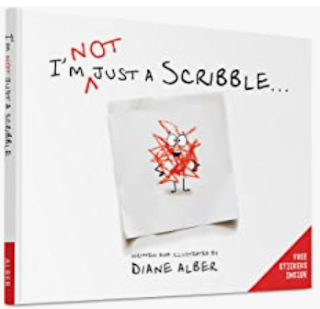
Here's the link if you'd like to check it out. Watch the embedded video for some bulletin board ideas! There is a totally precious book that goes with this special celebration, and I have already ordered one as a bonus birthday gift (along with some crayons and paper so we can start scribbling immediately). 

Starting With a Scribble Rainbow City Learning

Speaking of scribbling...

And speaking of scribbling, Tyler Henry has a new show on Netflix. I had heard of him, but never had seen any of his tv work. Last night, while scrolling through Netflix to find something that hubby and I could watch together, his new series popped up. As only one of us is interested in psychic mediums in the least, I found myself alone with the remote. If you have never heard of Tyler Henry, he is quite an accomplished psychic medium and previously worked with many Hollywood stars.

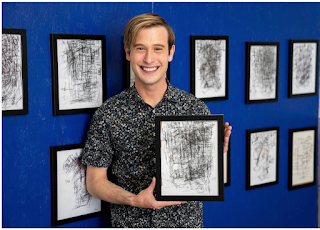
What I found most compelling about Tyler's practice is the way he constantly scribbles while he is doing a reading. He carries a notebook and it is filled with page after page of what looks like aimless scribbling with a black ballpoint pen. Here are some examples of his scribbling, and I LOVE how they are framed as art! This picture is courtesy of Netflix, where you can binge his new show!

Tyler Henry with HIs Scribbles Rainbow City Learning

When questioned about his scribbling during readings, Tyler shares that he has done this since he was a student, and that the repetitiveness of scribbling frees his mind to receive messages. As my teacher brain kicked in, I could really see the usefulness of this as a tool for studying, or for listening to a lesson. I've always encouraged students to draw and doodle in their journal while writing daily entries, taking notes, or revisiting a notebook or journal entry. But aimless, seemingly mindless scribbling? Never occurred to me. Now, I want to dive back into someone's classroom and try this! I also see this as a great tool for anyone of any age for meditation and relaxation. A cup of black ballpoints and some paper could be a great addition to our calm down corners!

Please, please, please come back and comment below if you add scribbling to either your classroom or personal practices, and tell me how it's working for you! I plan to try this myself and will come back to edit this post when I have some results!

Calm Down Corner
If you are looking for other resources to use in your Calm Down Corner, I hope you'll check out what Rainbow City Learning has to offer! Click here for 40 ideas, or just click below for these popular posters!


Wishing you peace and calm in the days ahead, and inspiration to start with a scribble!


If I can do anything else to help make your job easier this year, please let me know in the comments below! If I use your idea for a new blog post, you will win a TpT $10 gift card. If I create a new resource for Rainbow City Learning based on your idea, you will win a free copy of that resource to use in your classroom! (Note: all comments are reviewed before appearing on my blog. It may take a few hours for your comment to appear! Thanks for your patience!)

For more thoughts on teaching as we head into Spring, don't miss these posts by our awesome members of Teacher Talk!  

If you would also like to be a part of Teacher Talk, we are a group of teacher bloggers who share posts
that are heavy on the ideas with just a little selling of our educational materials at    TeachersPayTeachers.com.  For more information about joining The Best of Teacher Entrepreneurs Marketing Cooperative, go to https://bit.ly/3o7D1Dv.  Feel free to email me at retta.london@gmail.com if you have any questions. 


You are invited to the Inlinkz link party!

Click here to enter
1

Greet Students With the Arts

 Yeah, I spend way too much time on Facebook. It's hard to resist especially during this past year apart. All my friends are in there! I can pick up my phone or iPad, or turn on the computer, and find family and friends right there. I can interact a little, feel comforted, and step away. (Well, most of the time I can step away!) It has definitely become more of an addiction during the past year though.

During one of my recent forays into Facebook, I ran across an open post from a former school superintendent. Her name is Teresa Thayer Snyder, and she is the former superintendent of Voorheesville School District in New York. Dr. Snyder had some excellent advice for our return to school, originally posted on her own Facebook page, but currently spread far and wide all over the internet. Dr. Snyder is a fierce opponent of the catch them up and test them philosophy. Rather, she asks teachers to welcome their students back with art supplies and writing materials, with music and dance, with every avenue of the arts that will help the children to tell their stories, to enter into the historical record the many ways in which the past year has changed their lives. 

Dr. Snyder is a woman of my own heart. Exactly the way my classroom ran for thirty six years. Welcome them in with a love of the arts, and make sure that they have every opportunity to tell their stories. I've blogged about all this before, and will include a roundup of those posts at the end of this post. Never has there been a more important time to be soft and comforting with kids, to allow all the time in the world for them to get acclimated to school in person again, and to encourage them to tell their personal stories. 

On a personal note myself, a former student who was going through some life issues recently asked me if I could just pull something out of the closet in Rainbow City (what we called our classroom) to make it better. Thinking back on what I might have pulled out all those years ago, I'm pretty sure that it was as simple as some art supplies, writing materials, and maybe a little background music. (And, oh yeah, glitter. If you truly know me...) Stir these ingredients gently and add a dash of time, and you just might be able to help your individual students to heal from our shared trauma. When I'm trying to heal myself these days at home, that's just what I do - head to my art room. (The children have grown and are gone, so their rooms can be whatever now.) Once inside my art room, I pull out the journals, paints, brushes, and glitter and turn on the soft rock station. Might even dance a little. No one's watching. I promise you that it's much more healing than cramming for a test.

School districts now are actually considering ditching the standardized tests. I hope that for each of you, that comes to be, and I hope that you will be planning some art-infused activities to gently return to learning while honoring what your students have been through. 

You might start with a "Bucketful of Shivers" activity as detailed in this post. Simply, this activity gives kids a chance to throw away some negative thoughts and to start banking some positive thoughts. We all need a bank of positive thoughts to drown out the negative when we encounter those. Pretty easy to make buckets out of construction paper and pretty easy for kids to decorate them with crayons or markers!

You can find a lesson on creating a memory box and filling it with a special moment story in this post. This is a private way for students to write about a special memory with a loved one. Stories can be about a grandparent that they might not have seen for awhile, or could be a private way to remember and honor a family member that they may have lost. 

How about dancing in a storm in your dress clothes? Remember dress up clothes? I hear they'll be replacing our sweat pants soon. Hope some of mine still fit. 😂 Why not put on some music with a prompt to dance right at your socially distanced desk, imagining a certain situation, like wearing your pajamas in a softly falling snow, or wearing a tee shirt and shorts as you sink your toes into the sand at the beach? Wearing your ski clothes and trying to dance on a merry go round. Your kids can come up with much better prompts, I'm sure! Here's a post about a free lesson to get the fearless learning ahead started! I would absolutely do this dancing in a storm in your best clothes thing the very first day back! 

I wrote a post in June of 2020 after reading Glennon Doyle's book Untamed. Lots to think about "burning it down" with regard to how we used to teach and finding freedom in teaching in new ways. We are forever changed by what we have all been through during the pandemic year. All of us. Teachers, families, children. What a perfect time to let go of the past and move forward in a way that fits who we are now. Here's my take on Untamed Teachers.

Try some letter writing. Step away from the screens. Let your kids decorate the stationery and write the letters in their own handwriting. Letters to themselves during the last normal school year that they had, and letters as you go through the year to their future selves. Find a lesson on reaching out to future selves here.

Bring in a bagful or bucket of rocks and break out some paint. Let your students spread some positive words for others in your school by painting and spreading rocks at the entrance. Find a post about sharing our One Heart here.

Click here for a post about the need to give students the time and space to tell their stories.

And finally (for this post anyway), find a plan for using the arts mixed with literature to teach perseverance.

I would love love love to hear about an activity that you are using to welcome your students back that integrates the arts! Tell me please in the comment section below! 


For more thoughts on teaching in March and April, don't miss the following posts by the members of Teacher Talk! If you would also like to be a part of Teacher Talk, we are a group of teacher bloggers who share posts that are heavy on the ideas with just a little selling of our educational materials at TeachersPayTeachers.com.  For more information about joining The Best of Teacher Entrepreneurs Marketing Cooperative, go to https://bit.ly/3o7D1Dv.  Feel free to email me at retta.london@gmail.com if you have any questions. 


If you are so kind as to comment on my post, please know that all comments are monitored and will be posted when approved. (You may not see your comment right away after you post!)


You are invited to the Inlinkz link party!

Click here to enter
1

Small Moment Stories

March 7, 2020 was the last time I went out for a meal with friends.Yeah, I know about outdoor dining, igloos, and tents, socially distanced tables, etc. I just have been afraid to try any of it. Not judging those who have made it work for them. Just not for me. Yesterday though, hubby and I met an old friend in sunny Orlando, and sat at a very distanced picnic table at an absolutely adorable little breakfast/lunch spot called Eola General. It was delicious in every way - a delicious lunch and an afternoon filled with delicious gifts of the soul. 

My mind is filled with the precious moments of today, precious moments of the past, and the promise of more precious moments to come once enough of us get vaccinated. As I dozed on and off in the car on the way home (Hubby driving, not me!), my teacher brain traveled back to that time when I convinced my sweet students that every lesson that we shared together and the time we spent learning it was like opening a precious gift. Yes! They bought it! Of course they did, because I believed in it so much myself, and they could tell. You know yourself that's how anything that you teach works. If you're really feelin' it yourself, it's easier to bring your learners along with you. We had a song to describe what we were feeling from the creative mind and studio of Lessia Bonn. Here's a little video about it that we collaborated on: Gift in This Present 

Moving from the simple thoughts of just spending an afternoon with a friend, and how precious these small moments in time are, my teacher brain circled back to teaching kids to write personal narratives by capturing and writing stories about those small moments. As "March is Reading Month" is upon us, along with "Women's History Month", and following "Black History Month", along with the uproar over newly discovered issues with Dr. Seuss, I am thinking this: How about a Faith Ringgold author study?

Faith Ringgold, artist, author, teacher, and woman of color, wrote twelve children's picture books, about small moments that stayed close to the heart and small, to small moments that became monumental ones. My favorite way to study and take mentorship from Faith Ringgold is through the Quilt Story. Ms. Ringgold combined her love of art, storytelling, and fabric design in her quilt stories. Tar Beach is a perfect place to start. It's a quilt story based on a small moment from Ringgold's childhood. The story takes place on a rooftop summer night in New York, when, as a child, Faith dreamed that she could fly. A delicious memory!

Faith Ringgold holds a special place in my heart because, in her promotion of her soon to be published (at that time) My Dream of Martin Luther King, she visited a library not too far from our school. My students were invited to present their small moment quilt stories that they had created to her. She celebrated and treated them like real authors along with the parents and teachers who attended. 

If you have ever browsed in Rainbow City Learning, you may have noticed a quilt activity or two (or twelve). It's an activity for individual or group participation that my students have loved over the years. Class created quilts make awesome displays in the classroom or hallway. I am currently working on a clickable online version as well. Stay tuned! (Join my mailing list for an upcoming free sample!) Translating a quilt activity to a story quilt is an easy leap to make. Here is a quick teacher created tutorial that you can show to your students: Small Moment Story Quilt. A story quilt basically has two elements: a central image showing a small moment and the story told in words around the border. Second and third graders should be able to write a few sentences around the border; I expect a few paragraphs from fourth and fifth graders. An alternate way to create the quilt square is to place the text in the center square and then pictures around the border. 

Here's a quick link to some of Faith Ringgold's books (not an affiliate). I was surprised to see just now that the winter of 1998 was the time that my students met Faith Ringgold. We had been creating those story quilts since school started in the fall of 1997! The years have slipped by in an instant! Yet another reason to collect as many precious moments as you can! Some of the teaching days and weeks are long, but the years just slip through your fingers! 

A few more resources that I found to bring the magic of quilt stories to your students:

Anchor Books for Small Moment Writing

Mentor Texts for Teaching Small Moments Writing

Whitney Houston: One Moment in Time

Big Love, Small Moments (I thought this one was PERFECT!)

Faith Ringgold reading Tar Beach

Learning Art Through Faith Ringgold's History

Getting to Know Faith Ringgold

A related blog post about using the "Gift in This Present" theme can be found here: The Gift of Time

Happy March, everyone, however you choose to celebrate it! 


For more teaching inspiration for February/March, check out the amazing Teacher Talk blogs below. If you would also like to be a part of Teacher Talk, we are a group of teacher bloggers who share posts that are heavy on the ideas with just a little selling of our educational materials at TeachersPayTeachers.com.  For more information about joining The Best of Teacher Entrepreneurs Marketing Cooperative, go to https://bit.ly/3o7D1Dv.  Feel free to email me at retta.london@gmail.com if you have any questions. 

If you are so kind as to comment on my post, please know that all comments are monitored and will be posted when approved. (You may not see your comment right away after you post!)

You are invited to the Inlinkz link party!
3

Telling Our Stories


Who tells your story? Your parents tell it back to you at first, all the tender and embarrassing moments that you were too young to place into accessible memory at the time.  For most of your life, you tell your own
stories: to new and old friends, sometimes to strangers, to those who already love you or who may be falling in love with you, to your own children and grandchildren. After you are gone, your stories are held by those who knew you best: siblings, children, grandchildren, friends, former students, and former colleagues. If you have kept and left diaries, generations to follow in your family will come to know you as if you walked the earth together. If you become famous your lifetime, future biographers will tell their own versions of your story.

Eliza Hamilton tells us Alexander's story, as well as her own, in the Lin-Manuel Miranda song from the play "Hamilton". I know you've been singing or humming it to yourself since the first line of this post. Right? Eliza asks us, "And when you're gone, who remembers your name? Who keeps your flame? Who tells your story?" She also tells us, "I put myself back in the narrative." That line turns our teacher brain right away to personal narratives, often the first writing genre we try to teach, drawing from personal experiences, the stories our students love to tell. They love to tell their stories orally, yet are often more reluctant to start writing them down. We all know the experience: a flurry of raised hands, one child is recognized to speak, and the response begins, "Once....." Uh oh, not an actual answer, but a story. What do you do? Honor the need to tell our stories, or try to swing the focus back to the standard that must be taught in that 40 minute block? Not an easy choice, yet one that each of us makes several times at least every day. I have been guilty so many times of not only telling my own stories, but of allowing more than one student to get personal with their responses. The challenge to me as an educator was always how to draw the connecting lines so that the time spent will be meaningful in advancing the lesson for all.

Teacher Takeaways

I've been spending way too much time on ZOOM lately, and I don't have a class of students to meet with. Two ZOOM meetings and a Facebook Live each day for three days in a row this week made me feel your pain even more strongly, teachers. I applaud you and pray for you. One of my Zoom calls this week was a meeting of the three congregations affected by the Tree of Life mass murders two years ago. They were meeting to discuss a new book filled with narratives written by those who were either directly involved, or were close to the area or to the victims of the tragedy. My uncle is a survivor of that horrific attack. He deals with the after effects every day, and when he told me about the book and the meeting, I asked if I could attend. The book is Bound in the Bond of Life: Pittsburgh Writers Reflect on the Tree of Life Tragedy, edited by Beth Kissileff and Eric Lidji.

I was drawn to this topic at first because of my family's connection, but as I looked inside the book, I noticed that one of the writers had once, long ago, been a third grade student in my classroom. Of course I wanted to see how his writing had improved since third grade! I ordered the book on the spot! Listening to the writers as they read and discussed excerpts from the book, there were so many teacher takeaways. Two takeaways stood out from all the rest to me as a teacher. Neither was new to me, yet their importance surged in my mind, given our current situation in this age of the pandemic. One is the cathartic nature of just being able to tell your stories. The second is the way the same story is different when told by different people. Each of these, I believe, is important enough to make telling our stories a vital part of our teaching practice this year.

A Catharsis

Kids need to tell their stories. It's a release and a relief. Emotions are running strong right now for all of us. Stuffing our feelings deep inside isn't healthy, and storytelling can be a release. Kids need to be scaffolded into this practice. Start by honoring those responses that start with, "Once...". Plan for lots of short story responses in your morning meetings, and in the first moments of your lessons. Don't let the pandemic and our "new normal" be an elephant in the room beyond the screen. Bring it forward and encourage your students to talk about it. Becoming comfortable with talking about it can become a comfort with writing about it.

Text to Self becomes Text to World

Beginning with these mini oral histories and moving to journal entries, you are well on the way to longer, more traditional personal narratives. As kids start writing in journals, we need to be accepting of short answers as well as longer ones. A good way to ease reluctant writers into the practice is to allow drawing, diagramming, and even stickers to help fill the page at first. Most kids enjoy sharing their journal entries aloud. I wouldn't require it, but gently encourage it whether in small focus groups or with the class as a whole. An online bulletin board would be a great way to anonymously share some journal entries with the rest of the class. 

As you begin to teach personal narrative writing, journal entries that your students have been collecting are a gold mine of topics and prompts for writing. Kids can mark pages that they choose for future narratives with yarn, ribbons, string, sticky notes, or stickers that extend beyond  the page.. (Try sticking a second sticker to the back of the extended sticker to make it a little more long-lasting.) If you are collecting journal entries to show growth through the year as writers, journal entries paint a pretty accurate picture.

As I mentioned in my second takeaway above, writing about the same topic or event will look very different and unique from writer to writer. Many interesting and valuable lessons for writing can be drawn from this. Point of view, compare-contrast, even the basic elements of introduction, plot, characters, problem, and resolution will look different from student to student. The global lesson from this may be that it indeed matters very much who tells our stories.

I started a list of discussion/writing prompts to get you going, if you'd like to explore this more with your students. Just click below, and it's yours! (Background by Workman's Wonders on TpT)


For more ideas for moving from storytelling to journals to personal narrative writing, I hope you'll take a look at some of these classroom-tested resources from Rainbow City Learning! Just click here for the "Telling Our Stories" resource group.

Whatever your story, I wish you peace n the days ahead. Be well.


For more teaching inspiration for November/December, check out the amazing Teacher Talk blogs below. If you would also like to be a part of Teacher Talk, we are a group of teacher bloggers who share posts that are heavy on the ideas with just a little selling of our educational materials at TeachersPayTeachers.com.  For more information about joining The Best of Teacher Entrepreneurs Marketing Cooperative, go to https://bit.ly/3o7D1Dv.  Feel free to email me at retta.london@gmail.com if you have any questions. 


You are invited to the Inlinkz link party!

Click here to enter
2