Box 1

Box 1
STEAM

Box 2

Box 2
Character Education

Box 3

Box 3
Digital Learning
Showing posts with label New Year. Show all posts

New Year New Classroom


Aaahhhh...It's the beginning of a long break from the classroom. Maybe you've jetted off to someplace arm, or maybe you've chosen to snuggle in at home and just have a quiet week or two with your favorite books or hobbies. And yet, for the entire time, the spectre of returning in January may be hanging over your head and following you as you enjoy the merriment of this season. Keep reading for some ideas on how to combat that anxious feeling.

A new year, and yet another chance to get it right. Another chance to be the teacher they'll always remember, and to have the class that will stay in your heart for the rest of your life. Wait, what? You're dreading your return to school, worried about an unruly class of kids who have forgotten "how we do things around here", worried that they'll never settle in enough to pack in all the standards that you will need to cover before the next round of testing, or just worried that the peace and serenity that you found over break is about to crumble before your eyes. I've heard teachers talking about all that. Really. In many ways, the January return is just as anxiety-producing as the first day of a new school year. We've all just had too much time to get really used to not doing school.

Here are some resolution suggestions to help you and your students ease back in!
The Gift of Time

Time! Don't you wish you had more of it? So do I, and so do your students! Why not resolve to schedule some more choices into your day. I know! You don't have time! Right? I seriously always found that the time added to give kids a voice and a choice in activities was easily made up by subtracting the time I might have had to use to wait for the class to pay attention, stop talking, or just settle in.
Try giving your students a little more time in the day to read. Just read. Any book they choose, without a book report or reading log dangling from the edge of it. Just some time to indulge themselves as readers. You just might build a beautiful lifelong habit here!

Have you tried Genius Hour or any type of Project Based Learning yet? You could resolve to stretch your students' brains with a little more open-ended and less time-urgent work this month. They just might amaze you with all they can be motivated to learn!

Do your kids enter talking and keep it up all day long? Try surprising them with an occasional "conversational opportunity" during the school day - a time when it's a-ok to just talk with each other. Walk around and listen. Awesome sauce amazement!
The Gift of Kindness

Do you wish that your students were kinder to each other and maybe even to you? Why not make the teaching of kindness a standard for your classroom community? Infuse it in your lessons by finding examples of kindness as a theme in reading novels, biographies, and in studying current events. Find or write some math story problems in which the theme is kindness. (Hmmm... I think I'll do that myself!)

Remember to model kindness too. Please don't ever be afraid that another teacher or an administrator will think that you are being "too easy" on your class or that you are weak as a teacher because you are too kind. Been there. Heard that. My thirty six years of classroom experience affirms that you can never be too kind. Never. How can choosing to let other human beings know that you care about them and are there for them be wrong?


Talk about acts of kindness every day, maybe at a morning meeting, or just in passing as you notice them. In a kindness-focused classroom, the noticing will become more and more frequent over time!
The Gift of Peace

Aaah... Peace! Remember: You in your pjs or yoga pants, your coffee or tea or hot chocolate, the fire softly sighing in the background, soft music playing... CLASSROOM NOISE!!!!!! Ugh, back to reality! Well, maybe not. Why not try to recreate a little of that peace in the immediate environment of your classroom every day? Play some soft music while kids are working. Use music for your transitions. You might even bring up a screen saver fireplace video on one of your classroom computers. Remember to have a thermos of a warming and soothing drink that you enjoy, and let the kids have a thermos of their favorite on their desks. (Spillproof please!)

Here's an idea you might or might not have tried yet. Speak in a very soft voice. Even when your class is talking loudly all around you at first. Watch the fun as they strain to hear, nudge each other to listen, and then just focus in on what you're saying. Even if you think this is nonsense, how will you ever really know unless you give it a try? So many kids only know one volume level. They hear it at home, and they hear it all around them every day at school. Show them that the volume level is adjustable, and they have the power to turn it down.

Try bringing the elements of peace you have at home into the space where you spend most of your waking hours each day. Try a yoga break, a breathing break, or a short meditation time. Before you know it, school just might not be the place you need a break from. It might be yet another peaceful spot in your life.

The Gift of Safety

Everyone needs to feel safe and secure in the space where they are. Kids who feel threatened and under stress can't learn. You need to provide a safe zone within your classroom. You can do that by making sure your kids feel that they are noticed and heard and respected and cared for. Give them a voice. Show them that things happen WITH them, not TO them.

Make sure that your students feel safe in expressing their opinions and feel safe answering questions, even if they aren't really sure they have the exactly right answer. They need to feel safe to explore learning and new ways of thinking and looking at things.

 Home and neighborhood aren't the safest-feeling places for many of our kids. Make sure you know who your kids are and what challenges they find outside of your classroom. Then provide that place for them where they will feel safe and valued.
The Gift of Significance

Ownership. Authorship. Knowing that the work that you do is important and that it matters. This is a resolution that you can make today and give as a gift to your students every day. Frustrated that kids rush through assignments, turn them in looking sloppy, often with no name on it? You might want to try finding ways to lessen the paper load. Find some other ways for kids to respond: discussion, graffiti boards, individual and group performances, computer work. When people believe that work is valued and important, they don't forget to put their name on it. They're proud to announce that it is theirs!

Don't forget to celebrate the achievements of your kids often. When planning a unit, make sure that you add a plan for how you will celebrate the works produced by your students. Will you invite parents/community in to view your work, will you have a panel presentation, set up a fair, will kids make videos for students in future years to view, or will you invite another (perhaps younger) class in to be an audience? Celebrating at the end of unit is a great way to pause and say, "Hey! Your work has significance! You have made a contribution! Thank you!"
The Gift of Wisdom

Finally, you can resolve to give your students and yourself the gift of wisdom this year. Wisdom is an elusive and slippery little creature. You won't ever hear its soft voice unless your mind is quieted and you are listening carefully. Acquiring wisdom takes time and reflection. We can't stuff our heads full of facts and equations and then expect to emerge with wisdom.

You can share this gift with your class by offering plenty of reflective time for the lessons you are teaching. If you haven't tried Interactive Notebooks yet, this might be a good time. Just please, please, please make sure that your Interactive Notebooks are truly interactive. They really shouldn't even be about cutting and gluing. (Although that's the first vision that comes to mind for most teachers when they hear the term "Interactive Notebook". Admit it - that's the vision you had just now, too!) Don't make your Interactive Notebooks cutesy fill the blanks and color receptacles. Make them a place to collect valuable notes on the lesson, and then a space for reflection and individual responses to the learning. Time + Quiet  Reflection = Wisdom.

Here are some resource suggestions to support your use of any of these gifts this year!


                   TIME                                                                                                       PEACE           

KINDNESS

               SAFETY                                                                                              SIGNIFICANCE   


WISDOM
          
I hope you found an idea or two here to make your winter break and New Year return to school even better! Wishing you a year ahead filled with all the joy that makes you remember why you chose to be a teacher! 


For more ideas to make your January easier, cozier, and filled with learning, be sure to check out these bloggers talking about teaching.
For more winter ideas, please check out the fabulous bloggers of Teacher Talk! 

If you would also like to be a part of Teacher Talk, we are a group of teacher bloggers who share posts
that are heavy on the ideas with just a little selling of our educational materials at    TeachersPayTeachers.com.  For more information about joining The Best of Teacher Entrepreneurs Marketing Cooperative, go to https://bit.ly/3o7D1Dv.  Feel free to email me at retta.london@gmail.com if you have any questions. 


You are invited to the Inlinkz link party!

Click here to enter
0

Teaching Perseverance Through the Arts


"It's a country club over there," my parents could often be heard to say during my fifth and sixth grade years. We had just moved back to the neighborhood and new, progressive school that we had to leave after my Kindergarten year.
We had moved next door to my grandparents and my mom's large and loving family, so as a kid I wasn't aware of the financial difficulties that had caused the move "back home", just thrilled to be up in the business of my young aunts and uncle all.the.time. I was known as the world's youngest teenager, showing up at my Aunt Harriet's after school living room dance parties, and a careful observer of my Aunt Rhoda's makeup application and hair styling as she left for work or dates. They took me to the library every week for stacks of books, taught me to twirl a baton, and drove me to school. We had long and serious discussions about Elvis, Richie Valens, Buddy Holly, and the Big Bopper. A member of a for real actual singing group, The Tempos, actually lived across the street! Two of the songs that they briefly made famous were "Since I Don't Have You" and "See You in September". My grandma always said that Gene was a very nice boy who served his country.  I think he was a friend of my uncle, but who knows? My uncle always seemed to be in his room studying. That room was the only space in my grandparents' house that was off limits to me, but that was ok. He knew nothing about hair and clothes and makeup, and I just went in to look around when he wasn't there. We danced the Strand. We drew and colored, knitted, cooked and ate together, laughed together, and took full part in each other's lives. I missed nothing in the area of life enrichments, and I liked my school and friends.

BUT... the summer before fifth grade, life was heading in a positive direction for my very young parents. My dad finished college, had a CPA practice, and was beginning to invest in deli restaurants among other businesses. They bought their first home, and I returned to my original school in fifth grade while my little sister started kindergarten. Our little brother was nine months old when we moved in, so no school for him yet!

Apparently, while I was gone, our public school system had decided to try out some new programs and practices at the newest building in their district. When I arrived in Miss Brooke's fifth grade, things were happening! Kids who were academically successful appeared to have been placed together in class, so there was never a chance to read any of the books that I had become used to shlepping to school with me every day for four years. (Well, actually three years. Too busy throwing up every day in first grade when reading groups started. Membership in the blue birds was not all it was cracked up to be.) Aside from watching super smart kids learning and responding and interacting on all sides, we had ENRICHMENTS! Yes, our district was on the cutting edge in the 60s with the very beginnings of gifted education. They didn't call it GT or anything like that, but in my opinion, they should have named it something because the confused young parents just called it a "country club over there".
At the "country club over there", we could leave our classrooms without having to make up anything that we missed while gone, and take Creative Dance, Art Enrichment, Science Explorations, and Chorus. We could also learn square dancing and polka. Yes, polka. It was Pennsylvania after all! As a dancing school dropout, I loved Creative Dance the most. Could not believe my good fortune at being part of a group with actual current dancing school students.  (Being a dancing school dropout is absolutely true - I left Saturday morning dancing school for Saturday morning cartoons at the ripe old age of seven because I just couldn't keep up with the other dancers.) In Creative Dance, we were presented with music and could create our own choreography. It was amazing! My love for dancing, nurtured as the world's youngest teenager dancing with Bandstand every day, was restored!

I took that "country club at school" spirit with me throughout the rest of my education and my career as a teacher. As I got to higher grades, I learned perseverance. Perseverance made everything I tried to do better. Study and practice became enjoyable pursuits because there was always a goal ahead, a reason for persevering. I studied harder in French class so that I could spend more time in Ceramics class in high school. I studied for and passed out of basic language arts, foreign language, and math courses in college so that I could load up on Art History and Anthropology. And when I became a teacher, I tried to make sure that my own students had opportunities to explore the arts and sciences as much they possibly could. I did this through project based learning and through centers, including Inventor's Center, an early incarnation of STEAM. My students' journals always had a drawing/sketching/diagramming component. A kid more in tune with art could use more art than words and still succeed in journal writing. I can point to several professional artists today who have told me that they appreciated being able to journal through art in those elementary years.

After that loooonnnngggg intro, this post on Perseverance is turning to the importance of including the arts in an elementary education. We learn to be awesome dancers by dancing. We learn to be artists by crumpling papers, erasing, and starting again. We learn to be writers by writing. I always had two signs in my classroom: Good Writers Write and Good Readers Read. Perseverance is what makes us successful, and I believe that it is best learned in the pursuit of the arts.

When I was thinking of picture books to use with this important topic, I couldn't narrow it down any further than four. I simply took all four out of the library. You don't have to own every book that you touch. I donated three of these when I retired, and just discovered the fourth one. The public library is a great place to find books, especially books that you will use for a brief lesson. School libraries are another great source, if you are lucky enough to still have one. I won't speak badly here of the district that I retired from, but no librarians? Seriously?


The very first book that came to mind was Dancing in the Wings by Debbie Allen. In this book, Sassy is a dancing school student who, unlike yours truly, persevered. She was "too tall" and her feet were "too big" for all the roles and participation that she longed for. Rather than drop out, she practiced, observed, and danced every dance from the wings, learning it as well as if she was on stage herself. Her hard work and perseverance pay off when a director of an important Washington dance festival notices her, chooses her from her entire dancing school and invites her to be part of a performance troupe. This is based on Debbie Allen's life and the experience of her daughter Vivian in dancing school.

Of course, a read of Dancing in the Wings naturally leads to a read of Brothers of the Knight also by Debbie Allen. It's an amazing retelling of the fairy tale "The Twelve Dancing Princesses", and in light of the recent public controversy over whether men should be dancers, it got my attention. In Brothers of the Knight, Reverend Knight is a single father raising twelve sons. The story is narrated by their dog, Happy. Reverend Knight is befuddled by the fact that his sons' shoes are tattered, torn, and generally wrecked every morning, although they appear to have been sound asleep every night. A new housekeeper solves the mystery, and the brothers come clean about their passion for dancing. They had thought it necessary to sneak out to the ballroom at night because they thought that their father would disapprove. Reverend Knight marries the housekeeper, adds dance to his sermons, and all live happily ever after. Dancing with perseverance can sure wear out your shoes!
And speaking of shoes, a story from the childhood of Michael Jordan, Salt in His Shoes, is another great example of how perseverance can lead to success. Michel Jordan was once a short child who wanted to play basketball with the neighborhood kids. He was shorter than they were and had a difficult time keeping up. He measured himself over and over, but never seemed to grow. His dad advised him to keep practicing and his mom advised him to put salt in his shoes and to pray every night to be just a little taller each day. Michael took the advice seriously, praying, salting, and PRACTICING at home. He eventually scored the winning point in a neighborhood game when another player was injured and unable to play. And... as we know.... he grew to be a famous six foot six pro basketball player! Was it the salt? Or the perseverance?
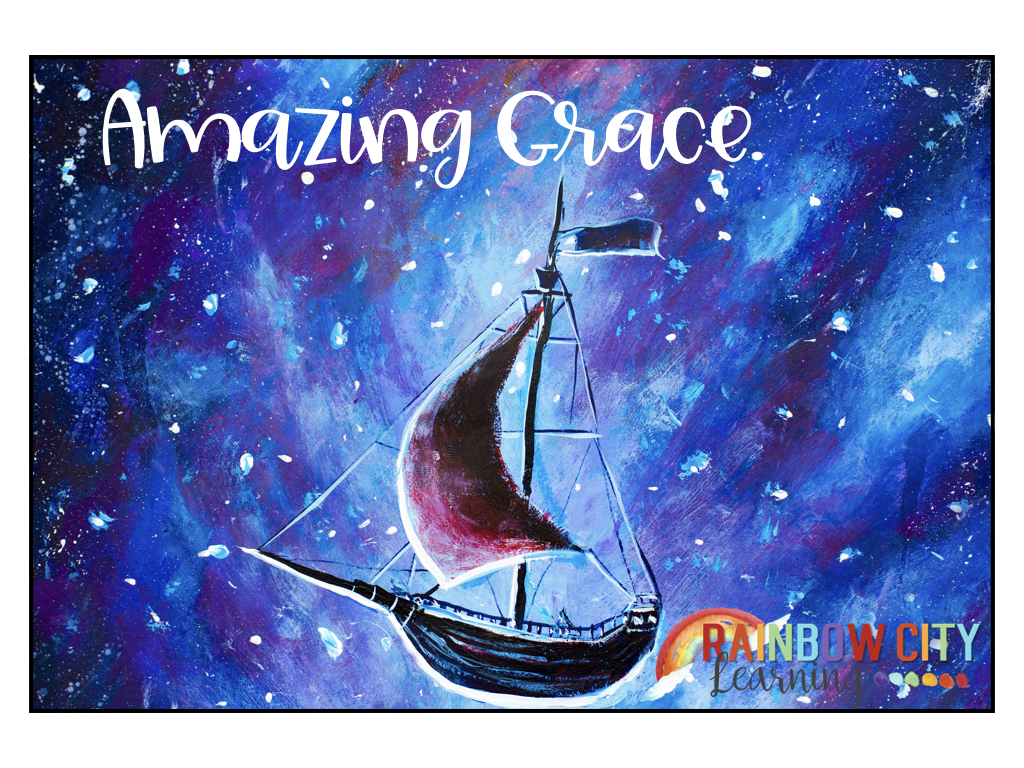
Amazing Grace by Mary Hoffman is also nothing short of amazing as a model for perseverance. Grace loves to read and to act. She loves stories - telling them, hearing them, acting them out. When she learns that her class is about to cast and perform "Peter Pan", Grace wants to be Peter. She is focused on her goal, and sticks with it through practice and auditions even though one classmate tells her that a girl can't play Peter, and another tells her that Peter is white. (Grace is African American.) Enter Grace's Ma and her Nana (gotta love the Nanas!), who inform Grace that those two kids who discouraged her don't know anything. Nana then takes Grace to a ballet performance where a famous brown-skinned dancer named Rosalie Wilkins ballet dances the part of Juliet in "Romeo and Juliet". After the performance, Grace adds the dance of Juliet to her practice, auditions for and gets the part of Peter Pan. Grace is an amazing Peter Pan, and according to her Nana, "If Grace put her mind to it, she can do anything she want." True for Grace. And true for all of our kids.  Putting your mind to it is perseverance!

Sometimes I wonder what might have happened if I had chosen to stick with Chorus when I was told by the teacher to sit in the back where no one had to listen to me. I could have been a famous singer! Nah, I just pursued the arts that mattered to me. Teachers, the important thing is to present the arts as possibilities to our students. Let them tinker and explore. Let them respond to assignments and projects infusing a piece of the arts that is important to them. Find time for performances in class. There are ways! Make your room just a little bit of "a country club over there". You never know what future artist, dancer, singer, writer, or scientist is sitting right before your eyes!

Check out some of the STEAM resources at Rainbow City Learning to add a little art to the learning in your classroom!


Click below for a FREE introductory lesson on using the arts to teach perseverance.


To hear the thoughts of our "We Teach So Hard" blogging group on this topic with lots of book suggestions, just click!


For the blog posts of our We Teach So Hard podcasters, click below!


Using the Arts to Teach Perseverance

And... before you go... Check out some amazing posts for the month ahead from my awesome blogging buddies at Teacher Talk!


You are invited to the Inlinkz link party!

Click here to enter
0

Getting Kids to Write

Ideas for Kids Writing

I've joined a new book club, and the discussion this week was mind-blowing!  We were discussing The Secret Keeper of Jaipur (sequel to The Henna Artist) by Alka Joshi, and our leader informed us at the end that this author's first book was written when she was fifty-one years old! Given that our group was comprised of women of that age and older, that information caused our discussion to veer in a new direction. When the member seated next to me pointed out that there are "so many ideas floating around out there", I grabbed her arm (gently, of course...), and said, "BIG MAGIC!" All was suddenly quiet. All eyes on me, the new girl. Undaunted, I repeated, "Big Magic by Elizabeth Gilbert!" Blank faces. "You know," I went on. "The author of Eat,Pray,Love. She also wrote a book about imagination and how ideas find us." A little more interest. (Several teachers in the group.) I continued, "She said exactly what Christina just said, that ideas are free-floating in the universe, and they find us if we are open to it. If we allow the ideas to find us, we can do or write about almost anything. My friends know that I call this phenomenon 'Blog Fairies' whenever I sit down to write a blog post." 

Where Do Ideas Begin?

I love to read about and listen to interviews with my favorite writers. The common element that I have found in all of this drilling down on their creative process is the quiet surroundings and sitting with their thoughts. Just being quiet and allowing the ideas to find you. If you do research about a favorite author of yours or of your students, you will find a regular person who stood still long enough for an idea or two to find them. 

I currently have two hardcover copies of Big Magic, a Kindle edition, and an audio version. I refer to them alllll the time. If you only read one chapter, try the one about the time that the very same idea had approached both Elizabeth Gilbert and Ann Patchett. Elizabeth ignored it because she was busy with something else, and Ann wrote the book! Read about how they discovered this secret of the universe as it affected them both. The chapter is titled "WTF?" because you know... how could this be? It happened! 

Teacher friends, this concept can so easily be applied to our classroom practice. Even the most reluctant writers can be drawn in with this magical idea. Believe what you will, but something in the universe or within each of us as humans, offers ideas and opportunities on a regular basis. We choose, whether consciously or unconsciously, to tune in or tune out. We can bring this idea into our classrooms to get the writing started and to keep it going. This is no cookbook plan on how to teach writing step by step, but rather some suggestions for creating a community of writers within your classroom.

Authors Lead the Way

Author Kristen Hannah today on her FB page: "Honestly, it's always kind of a surprise to find that I can write a book!" 

Author Jodi Picoult on what to write: "...for many years, I had to squeeze in my work around child care schedules, and that made me develop a very firm discipline. I write quickly, but I also do not believe in writer’s block, because once I didn’t have the luxury of believing it. When you only have twenty minutes, you write - whether it’s garbage, or it’s good… you just DO it, and you fix it later."

Natalie Kinsey Warnock, author of Gifts From the Sea: "Every family has stories that are too good to be forgotten, stories that need to be written down and told and passed on to the next generations." My favorite memory of an author interview with this author was when she held my students and me spellbound with her sharing of how she came to write Gifts From the Sea. She was in her studio, working on another book. Quila, a character in Gifts From the Sea, kept showing up as a voice in her ear saying. "Tell my story. Tell my story." Over and over, until she could ignore it no longer. As she put down her other work, closed her eyes, and sat with the quiet, Quila's story was revealed to her and became a longtime favorite book for the middle grades. 

Beloved children's author Patricia Polacco describes her family members as marvelous storytellers. "My fondest memories are of sitting around a stove or open fire, eating apples and popping corn while listening to the old ones tell glorious stories about their homeland and the past. We are tenacious traditionalists and sentimentalists.... With each retelling our stories gain a little more Umph!"

From my current literary obsession, Black Cake: Author Charmaine Wilkerson created this novel from thoughts about a cow shaped potholder, a blue pie plate, and an old family recipe given to her by both sides of her fractured family situation growing up. "One’s sense of family and home may shift over time, but it remains embedded in our hearts and our sense of self wherever we go." 

Author Joyce Maynard leads writer's retreats several times a year at her beautiful home on Lake Atitlan in Guatemala. These are memoir writing workshops for people who have never tried to write a book, but want to explore what they have inside them.  When asked in an interview about the sequel she's currently writing to her newest book, Count the Ways, she said that she can't wait to find out what's in store for one of the characters in the first book! What?!? She can't wait?!? Isn't she the author? But what she is telling us is the same thing others have said, that the characters reveal themselves to the writer much like they do to the reader. Jodi Picoult describes it as a movie playing out in her head.

Lessons for Our Young Authors 

I could go on and on (probably already have!) about thoughts from my favorite authors, but here are some takeaways that I think will be helpful in our classrooms:

  • Be still and quiet and allow ideas, floating around like butterflies, to land on you. 
  • Start with a word, a drawing, or even a scribble. Just touch a pencil to paper or place your fingers on the keyboard, and begin.
  • Tell your own stories and stories you've heard in your family.
  • Start with a favorite favorite family recipe or artifact like a quilt and tell its story or a related one.
  • Let the story lead you, and let the characters take you where they want to go.
Get the Party Started

Shhhh.... It's a quiet party! Try creating an oasis of peace and quiet when writing time arrives. Play some soft music as an invitation to gather materials and find a quiet writing space. Some days, just give kids a quiet room, a favorite spot, and then the gift of some time to write. Some days, try an activity or game to get the juices flowing. Some activities to try:

  • The never-ending story. Start with a first sentence and pass a talking stick or ball or whatever around as each kid in turn adds the next line. You will want to video or record these! Many are keepers!
  • The quick write. Give a prompt and and allow a timed response time. Anything from 4 to 10 minutes. As Jodi Picoult says, just write! Even if you think it's garbage. It can always be revised later. It's fun to record the number of words written each time, and see the growth! 
  • A picture or quilt square about a family story or tradition.
  • Start with sharing a favorite food or recipe. 
  • Allow kids to talk about all of this at times. No writing. Just talking. It will inspire later attempts!
  • Free write time. Only rule is that you have to keep writing, no matter what you are writing.
  • Daily journals. I can't recommend this enough. So important! Kids can mine these for story ideas later on. When they don't feel that they can write, let them draw!
Don't forget to have a peek at Rainbow City Learning on TPT for some writing units, games, and conferring notebooks to help on this journey! Click below for a fun brainstorming experience!

Kids Ideas for Writing

If I can do anything else to help make your job easier this year, please let me know in the comments below! If I use your idea for a new blog post, you will win a TpT $10 gift card. If I create a new resource for Rainbow City Learning based on your idea, you will win a free copy of that resource to use in your classroom! (Note: all comments are reviewed before appearing on my blog. It may take a few hours for your comment to appear! Thanks for your patience!)


For more ideas to try this month, please check out the fabulous bloggers of Teacher Talk! 

If you would also like to be a part of Teacher Talk, we are a group of teacher bloggers who share posts that are heavy on the ideas with just a little selling of our educational materials at TPT. For more information about joining The Best of Teacher Entrepreneurs Marketing Cooperative, go to https://bit.ly/3o7D1Dv.  Feel free to email me at retta.london@gmail.com if you have any questions. 

You are invited to the Inlinkz link party!

Click here to enter
0

Games in the Classroom

Here we are, right in the middle of holiday prep, and looking forward to celebrating New Year's Eve! When my daughters were young and still celebrating New Year's Eve at home with us, I planned a menu of appetizers only along with Shirley Temple cocktails, starting at 3 pm and extending until we carried the little partiers off to bed. Generally, we "dropped the ball" (in our imaginations) around 10 pm. Between 3 and 10, we had a conga line once per hour and danced all through our house, a family tradition started long ago in the house where I grew up. We also played games while we munched on our tiny plates of apps. 

We went through almost every game in the house on those New Year's Eves, but spent the most time on Monopoly and Scrabble, our all-time favorites. We were expanding our language skills and sharpening our economic understandings without even realizing that was happening. We were interacting with each other, laughing together, and totally enjoying every minute of the celebration. If you have young children at home this holiday season, I can't recommend New Year's Eve Game Night highly enough! So many precious memories were made on those nights together!

Game playing holds as much magic in the classroom as it does at home. Games can be used to introduce new lessons, review and reinforce concepts already learned, and to develop skills such as problem-solving, critical thinking, and teamwork. My first experience with game playing in the classroom started when I was in Miss Brooke's fifth grade class. Miss Brooke had many games available to us in her games center, but my favorite was a bulletin board US map, where a blue light bulb would light up when you touched wires matching the state outline with its name. The learning I acquired there is still with me today. Go ahead, show me any state outline and I'll name that state! 

I carried Miss Brooke's torch and love for games into my own classrooms throughout my teaching career. In the early years, I made card games for vocabulary and math practice and stored them in empty Pringle's potato chip cans. I created board games for every Social Studies unit and dice games for reading. 

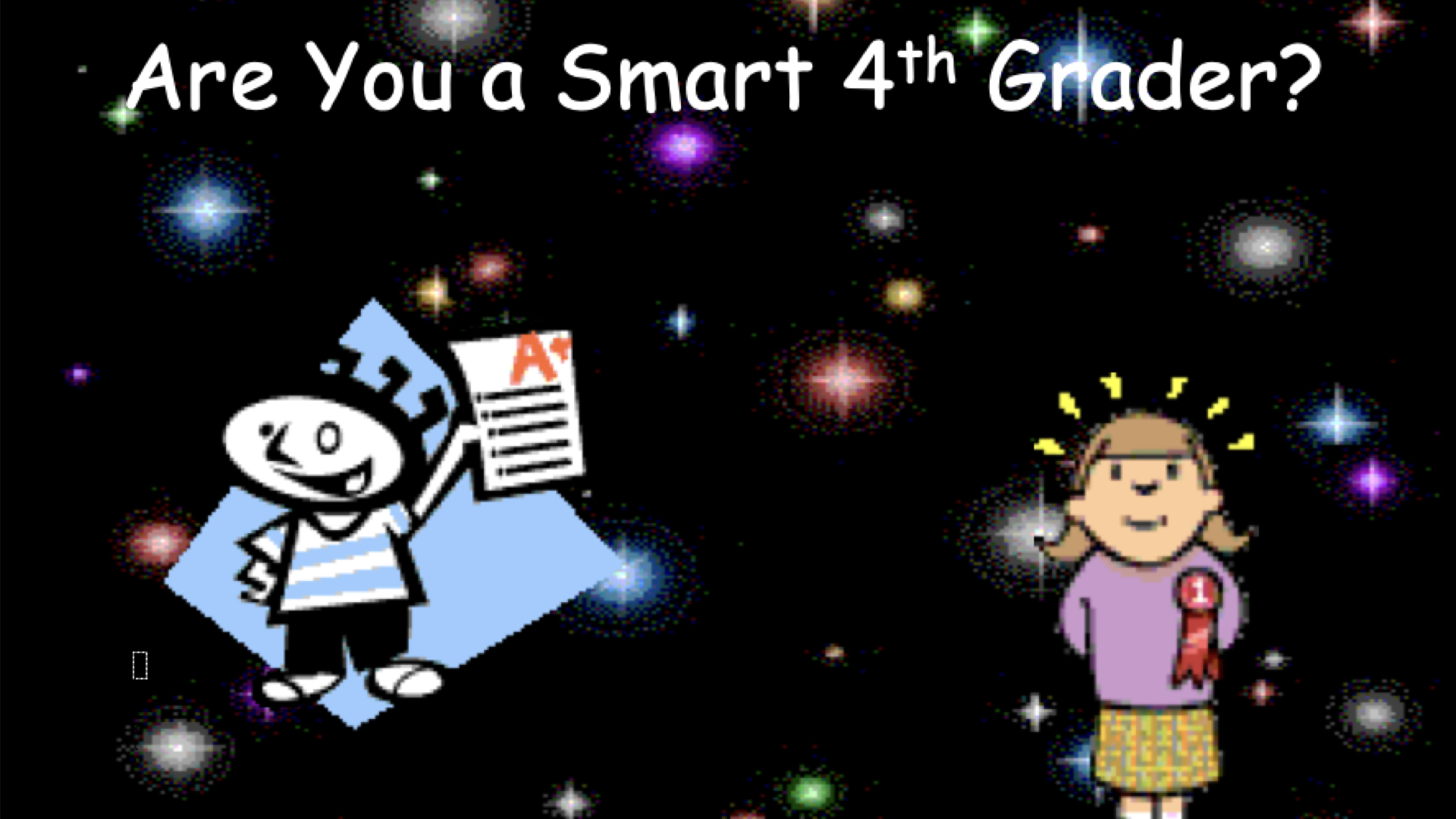
It's so easy to incorporate game playing into your teaching practices. I developed a review game with my students when the game show "Are You Smarter than a Fifth Grader" was on TV. Everyone watched it. It was part of the culture of our community. What fun to see fifth graders triumph over grownups! It showed that kids are smart, they pay attention, and have a lot of knowledge to share. I made a fairly simple power point with a slide for each subject and then inserted a question from a lesson we had learned that week. The question slide was linked to an answer slide. Three of my class jobs involved being the "Game Show Host", "Technician", and "Awards Committee". The whole class played every Friday in the time slot before lunch. Because what are you going to do then anyway, right? The host read the question as it appeared on the screen. The technician played a song loop on on our boom box. (Subliminal messaging works great here. The song we used for our peppy thinking music was "It Takes All Kinds of People" from Thanks and Giving by Marlo Thomas and friends. It took me forever to find this now long hidden gem on the internet, so I am linking it here for you. You're welcome! Make it your favorite ear worm. I can still hear it right now!) While the music played, kids wrote their answers on individual white boards (or laminated white card stock) with a wipe off crayon or marker. Each student kept an old sock in their desk to erase with. When the music stopped and the host said, "Show me!", each student held up his/her answer. Everyone with the correct answer received five rainbow city dollars. (Class Economy secrets here.) This simple review game became part of our class culture for years after the TV show failed. It was simply "what we do here" to remember and celebrate what we've learned and to get ready for tests.


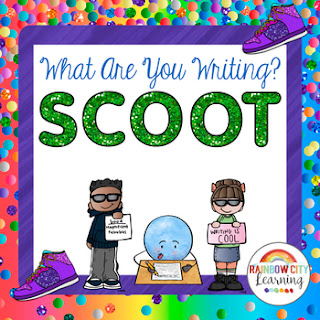
SCOOT games are another way to introduce or reinforce learning in a responsive way. Kids need to move! This game approach gets them up and moving. An important piece of SCOOT gaming, though, is the followup. It's important to give students time for debriefing and a little conversation with their peers. As they present their responses, watch their learning success soar! Look here for a little SCOOT inspiration!

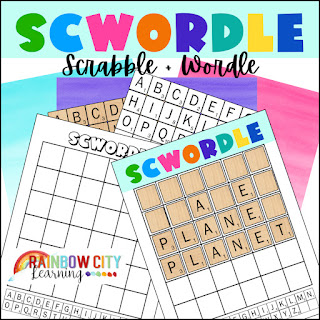
 My favorite game of the moment is Wordle. I literally can't get out of bed in the morning before I solve the Wordle of the day! In convo recently with my favorite seven year old, she said that she’d like to play Wordle, like the grownups do. That put my teacher brain in motion, and this is what I came up with: Scwordle! It's a combo of Wordle and Scrabble. Scwordle is a scaffoldable, challenging, multilevel and scored way for kids to play a Wordle inspired game using their spelling lists, vocabulary practice words, word wall words, words associated with a class novel or shared informational article, or words of their own choosing. Kids can play alone with word lists that you have suggested, or challenge their friends and classmates with word choices of their own. 

Learning to play this game will require some instruction at first, but students in grades 3-6 should be able to learn the rules quickly. Playing with partners is a great scaffolding hack! Remember that the goal of this game is to have fun with words. I promise that the learning will follow. Any changes in play that you and your students agree on are acceptable! If you try this board game version of Wordle, I promise that it will become the new favorite in your classroom. Playing this version has made me a much better online player too!

A final note about game-playing in class: Try setting up a game creation center in your class with some simple materials, such as cardstock, markers, dice, playing cards, bingo chips, spinners, and player pieces from discarded board games like Monopoly. You will be amazed at the games that your students produce to reinforce concepts they are learning in your classroom!

You can find my new Scwordle game here. I recommend making an extra set to play at home! Make it part of your New Year's Eve celebration!


Happy New Year, and best wishes for lots of game-playing fun and learning in the year ahead!


For more holiday season ideas, please check out the fabulous bloggers of Teacher Talk! 

If you would also like to be a part of Teacher Talk, we are a group of teacher bloggers who share posts
that are heavy on the ideas with just a little selling of our educational materials at    TeachersPayTeachers.com.  For more information about joining The Best of Teacher Entrepreneurs Marketing Cooperative, go to https://bit.ly/3o7D1Dv.  Feel free to email me at retta.london@gmail.com if you have any questions. 

You are invited to the Inlinkz link party!

Click here to enter
0

Read Aloud Magic

The Magic of Reading

 Ready to add some magic to your read-aloud? Reading plus gifts. What could be better? This post is a followup reveal to something that I teased in my last post! Who loves reading? Well, almost everyone. Who loves gifts? EVERYONE!!! By adding class gifts to your read-aloud, you can offer your students a magic portal to the world inside the book, as well as encouraging them to love reading just a little more than they already do. 

It all started on Mother's Day several years ago. My daughter gifted me a subscription to a book box club that would send a new book to me each month, along with four gifts that are mentioned in the book. As I read the book, I would reach a page with a sticky note that said, "Open Your Gift!" The gift, wrapped with a label showing the corresponding page number, was always a perfect way to hold a piece of that book in my hands. Example, in that first book, a "flower child" of the seventies approached the main character. She was wearing huge hoop earrings with fringes and a scarf in her hair. Inside the gift for that page was THOSE earrings and THAT scarf! Love, love, love! Right? In another book, the main character stepped out of her usual personality and stepped up to try karaoke. My gift for reading to that page? A karaoke microphone! The microphone was also rose gold - definitely speaking to my very soul! 

Sweetheart number six in my family has seen my book boxes in process and some of the gifts. She asked for a book box of her own for her recent seventh birthday, and I created two of them for her! She loved her  gifts! Clementine by Sara Pennypacker is one of the books that I gave to our sweetheart. As I've also used this in the past as a read-aloud for third graders, it occurred to me that this open-your-gift magic could also be done as a read-aloud experience in the classroom. 

Once Upon a Birthday Book Box

Yes, of course there was glitter on each sticky. Have we met?

I'm sharing here ideas for two read-aloud books that you could try this with. The first is recommended for grades 2-4 and the second would work with grades 4-6. The second one is my all-time personal favorite for an upper elementary read-aloud. I'm listing individual gift ideas, and then classroom "moments" (gifts suitable for a group). This idea would also work in small book club groups in your classroom. A great followup would be to ask students to select four stopping pages and four corresponding gifts for the next book they read. 

I hope you and your students will enjoy stepping through the portals into the story of your next read-aloud! I would love to hear from you in the comments below after you try this! Email me if you'd rather share your results that way!


Clementine by Sara Pennypacker

Page 18: "grabbed the box of markers from where my mom had hidden them"

individual gift: new permanent or paint markers

class moment: new markers added to community boxes, or an art break to paint a "flaming sunset".

Page 83: "The following students are excused from recess so they can catch up on their journal writing"

individual gift: new fun journal

class moment: extra time to add art, stickers, and other embellishments to journal entries, or time to share the reading of journal entries in small groups

Page 114-115: "Because I am so good at paying attention, I know all the things Margaret likes. So I ran around the apartment gathering them up."

individual gift: red Barbie shoes, a blue feather, or M&Ms

class moment: Stop and talk about collections that each student personally has. Could also plan a collection display as part of the celebration for completing the book.

Page 130-131: 

individual gift: stuffed kitten

class moment: cupcake decorating party - adding frosting, sprinkles, etc. Alternative: design and draw cakes that celebrate events other than birthdays


A Crooked Kind of Perfect by Linda Urban

Page 20-21: "...he would hand me a velvet box, and in it would be a diamond tiara..."

individual gift: tiara

"And the second thing is that she likes ginger ale..."

class moment: ginger ale tasting (Compare Vernor's to Canada Dry, Schwepp's etc.) 

Page 43: "And she gets socks."  

individual gift: unusual socks

class moment: wear (or draw) your favorite socks to class. Have a "wear your socks" day in class.

Page 76 -77: "So what's it going to be?" asks Mabelline Person. 

                     "'Forever in Blue Jeans', by Neil Diamond," I say.

individual gift: USB Flash drive with the five songs mentioned on page 76; doll-sized blue jeans 

class moment: dance break with the five songs mentioned above, vote for class favorite

Page 116: "My cake is beautiful."  "'It's perfect," I tell him." "'It's a crooked kind of perfect,' I say."

individual gift: cake mix, frosting mix, cake decorating accessories

class moment: design the perfect birthday cake for you (start with an art activity, but maybe choose one to     actually create and bring in to share at a later time. 

Page 184: "'Wouldn't that be funny if everybody wore shirts with true stuff on them?' Mona laughs."

individual gift: white t-shirt and fabric markers

class moment: design a t-shirt with "true stuff" about you 

For a complete unit on A Crooked Kind of Perfect, click here:

Reading Unit for Upper Elementary

For more Book Club ideas from Rainbow City Learning, click here!

If I can do anything else to help make your job easier,  please let me know in the comments below! If I use your idea for a new blog post, you will win a TpT $10 gift card. If I create a new resource for Rainbow City Learning based on your idea, you will win a free copy of that resource to use in your classroom! (Note: all comments are reviewed before appearing on my blog. It may take a few hours for your comment to appear! Thanks for your patience!)


For more thoughts on teaching as we head into the homestretch of the teaching year, don't miss these posts by our awesome members of Teacher Talk!  

If you would also like to be a part of Teacher Talk, we are a group of teacher bloggers who share posts
that are heavy on the ideas with just a little selling of our educational materials at    TeachersPayTeachers.com.  For more information about joining The Best of Teacher Entrepreneurs Marketing Cooperative, go to https://bit.ly/3o7D1Dv.  Feel free to email me at retta.london@gmail.com if you have any questions. 


You are invited to the Inlinkz link party!

Click here to enter
1

A Celebration of Values for the Holidays

Christmas and New Years

How do you celebrate "The Holidays" in your classroom? I have been seeing tons of pictures online, and honestly, most seem to be geared totally toward Christmas. Teachers dressed as elves, Ugly Christmas Sweater Days, Elf on the Classroom Shelf, and Christmas decorations everywhere. This always makes me pause and wonder if all the children in the classrooms whose posts I see are from Christian homes: homes that actually celebrate Christmas. 

I can tell you from my own childhood experiences that it is hard to be different during Christmas. It feels so lonely and alone. Even if they are not expressing this, many children are feeling this at this festive time of the year. 

For me, the celebrations at this time of the year are all about the values they instill in our hearts, not about the specific names or even specific religious practices. As a teacher of mostly diverse populations over the years, I have loved learning about the diverse celebrations that actually occur at this time of the year. The similarities have always amazed me. For one, the presence of candles in the rituals associated with so many of our winter holiday celebrations. Candles can symbolize so many different things, but they all succeed at bringing light and love into our hearts. Each of the winter holidays we have studied in our Rainbow City classroom has also come complete with lifelong values tidily wrapped up to reaffirm during the holiday season.

Celebrating Christmas

Celebrating Hanukkah

Celebrating Kwanzaa

And so, as we sing, wrap, greet, feast, and otherwise make merry during these winter months, it's also a great time to address values education with our children. What do we stand for? What's most important to us? What really lies beneath the shiny ribbons and glorious boxes?  Unless we teach in a religious school, we probably shouldn't be teaching religion at any time of the year. But values? Solid, character-building values? Of course we can address those!

In my opinion, Kwanzaa is a perfect holiday to address values that many of us hold dear already. This just may be the perfect year to get a Kwanzaa celebration going in all of our homes and classrooms, or at least in our homes in preparation for considering Kwanzaa as a more universal holiday to celebrate together in class next year. It is cultural rather than religious, and is filled with lights, colors, gifts, togetherness, and joy. 

If you prefer not to put a label of a specific holiday on your celebration of values, it will still work. Who could argue with celebration of unity in your classroom community? Or a celebration of the creativity that dwells within each of us? Responsibility? Self-determination? Purpose? Of course! All of these are so connected to what we try to instill in students every day in every lesson!

You might want to start by introducing a value each day (or each week) in your Morning Meeting discussion. Or start with journals. Start somewhere this year, and build on it next year. I have blogged about this before, but a favorite activity in my classroom for years was a carousel of holidays, where we shared the values, foods, and fun of each of our own special holidays. Here's a post you may be interested in:


For an actual Kwanzaa celebration or lesson, you might like this bundle I've put together for you!


Studying Christmas around the world may be fun and enriching for a homogeneous classroom, where all families celebrate Christmas. (Are you sure that EVERYONE in your class celebrates Christmas? Have you asked? Just asking again for a friend...that lonely child that I once was.) Even if you're positive that you stand before a truly homogeneous Christian class, taking a look at the values and celebrations of others can't hurt, and may be enlightening! 

Wishing you all the peace and joy that you seek in this holiday season!

I hope you have found a few ideas here to make this season of reflection more meaningful this year in your classroom. Please know that I am grateful for each and every one of you who reads this blog! 

If I can do anything else to help make your job easier this year, please let me know in the comments below! If I use your idea for a new blog post, you will win a TpT $10 gift card. If I create a new resource for Rainbow City Learning based on your idea, you will win a free copy of that resource to use in your classroom! (Note: all comments are reviewed before appearing on my blog. It may take a few hours for your comment to appear! Thanks for your patience!)


Christmas Celebration


For more great December teaching ideas, be sure to check out these Teacher Talk bloggers! 

If you would also like to be a part of Teacher Talk, we are a group of teacher bloggers who share posts that are heavy on the ideas with just a little selling of our educational materials at TeachersPayTeachers.com.  For more information about joining The Best of Teacher Entrepreneurs Marketing Cooperative, go to https://bit.ly/3o7D1Dv.  Feel free to email me at retta.london@gmail.com if you have any questions. 


You are invited to the Inlinkz link party!

Click here to enter
1